
Why is everything a challenge?
On trying (and failing) to fix my life in 30 days

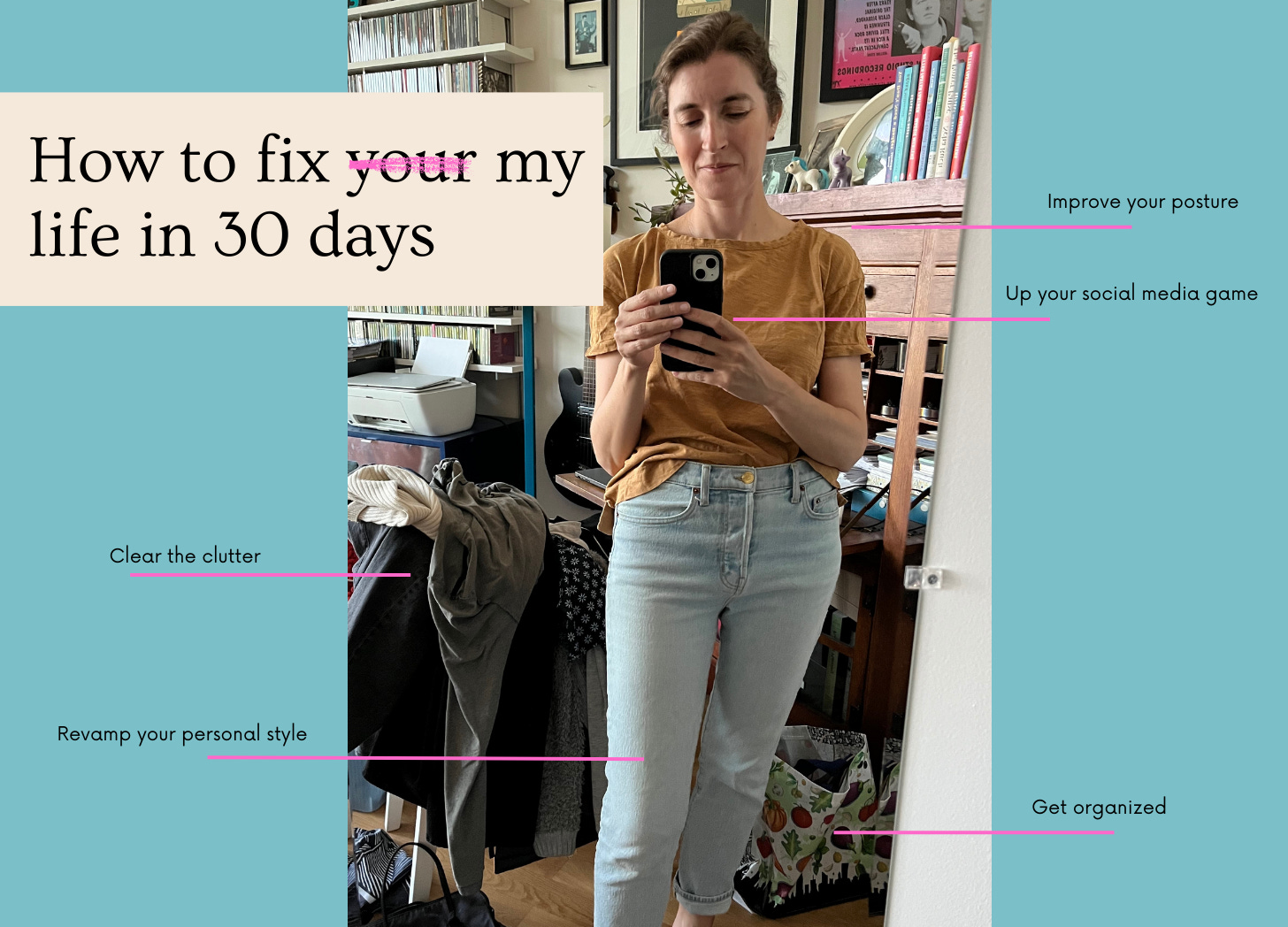
I love a personal challenge. If your publication offers advice on how I can declutter my house, perfect my plank, and revamp my personal style in 30 days or less, I’m going to read every word and then spend an afternoon (or long weekend) imagining how good my life is going to be once I follow the easy steps and finally achieve personal perfection.
But, dear reader, I will under no circumstance actually complete the challenge. And there’s a good chance I won’t even begin.
I’ve even written challenges encouraging other people to get their finances together in 30 days or save $528 in 32 weeks. I think I offer good advice, and at times, I’ve even thought, “I should follow this advice and get my finances together and document the whole process on Instagram!” No surprise: I’ve never followed through with my own challenges either.
In the early 2000s, some of my favorite bloggers set big challenges for themselves and turned their experiences into book deals. Perhaps my very favorite is Julie and Julia, where Julie Powell cooked her way through Julia Child’s Mastering the Art of French Cooking and chronicled the experience in a blog. She landed a book deal, which was adapted into a movie starring Amy Adams and Meryl Streep. I deeply admired Julie’s dedication to taking on such a massive project, and I loved her writing—it was funny, self-deprecating, and relatable.
But I have never thought of myself as someone who could pull off a project like that. Before I left Fortune in the summer of 2023, I always considered myself a company woman. I liked having a boss (when they were good bosses, of course). I liked having health insurance and a set number of vacation days each year. But most of all, I liked having deadlines and people who were holding me accountable. If I told a boss, coworker, or direct report I was going to do something, I was going to do it.
It was absolutely terrifying to leave that job and all its responsibilities to launch my own thing. I didn’t consider myself to be someone with a lot of self-motivation. How was I going to be my own boss?
I’m sure some of you are reading this and thinking, “Give yourself a break! You did launch the newsletter, and you’ve kept it up for 145 issues.” And you’re right, I have. But I have all of you readers to thank for that. I published the first edition of The Purse on June 1, 2023, because an advisor gave me a random deadline, and I didn’t want her to think I wasn’t serious about this idea. I published again on June 8, 2023, because I had told my first 200 readers that I would. I didn’t want to embarrass myself by not following through. There have been plenty of weeks when I would have liked to just take a break (this one included!), but readers expect The Purse weekly, and so I write The Purse weekly.
I’m told this makes me an obliger, according to Gretchen Rubin, another writer who, like Julie Powell, became popular during the blogging heyday of the early 2000s thanks to her blog (and book) The Happiness Project. While I followed Gretchen’s blog back in the day, I’m not sure what prompted me to return to her work in the last few years. But after listening to the audio version of The Happiness Project, I fell into sort of a Gretchen Rubin worm hole.
Over the last decade, she’s built an amazing career around challenges. OK, the publishing industry would categorize her work as “self-help,” with a focus on habits and happiness. But in my mind, she writes the best challenges. This year, for example, she created the “Read 25 in ’25 Challenge,” where she encouraged people to read 25 minutes every day in 2025. Even though I’m a self-proclaimed quitter of challenges, when I read Gretchen’s books, I believe that I can do better.
I mentioned in the August recap that this summer was interesting because it’s the first time since I launched The Purse that I haven’t been taking on extra freelance work. Except, I’d argue that having more time isn’t necessarily a good thing for me. I have no shortage of ideas and goals and dreams. But now I have to go execute them. And frankly, that’s hard! When I had a job with a boss, I could talk through my ideas, and we could decide together where I should put my focus. Now I am the boss of everything, and no one is telling me what to do. Some days (and weeks and months), I feel really unsure of where to put my attention beyond sending out this newsletter every week.
I’m sure I’m not the only self-employed person with entrepreneurial dreams who has a mile-long to-do list and trouble focusing. I recognize my own limitations. So this summer, I’ve been looking for advice wherever I can get it, and that’s why I picked up Gretchen’s book Better Than Before, her deep dive into the topic of habits: how to form good ones, break bad ones, and—perhaps most challenging—maintain those good habits for the long term.1
As part of her work on Better Than Before, Gretchen developed the idea of the four tendencies, where she essentially groups people into four personality types—upholder, obliger, rebel, and questioner. From there, she uses these categories to help people understand how they approach habit formation and how they can use this knowledge to form good habits and break bad ones. (You can take a quiz on Gretchen’s website to determine your type.)
When I chatted with Gretchen by phone a few weeks ago, I had just taken the four tendencies quiz, and the results showed I was an obliger. I have to admit, I felt sort of bummed that was my tendency. It just feels like of course the working mom is an obliger, always putting the needs of others ahead of herself. But Gretchen reassured me it has nothing to do with being a mom and plenty of men fall into the category as well. (In fact, most people are obligers—a lot of us need an accountability buddy to get shit done.)
Even though I sort of rankle at the idea of being an obliger, it checks out. The only times I’ve ever been successful at sticking to an exercise routine is when I had a friend joining me. (Miss you, Jen!) And I finally started flossing a few years ago because Ken did. We see the same dentist, and I didn’t want the hygienist complimenting him while chiding me.
I worried that being an obliger might make me a bad candidate for being a successful self-employed person. But Gretchen admits that being your own boss all the time can be difficult, even for her, an upholder.2 In Better Than Before, she shares an Andy Warhol quote that really resonated with me: “When I think about what sort of person I would most like to have on retainer, I think it would be a boss. A boss who could tell me what to do, because that makes everything easier when you’re working.”
“YES!” I thought when I first heard the quote, “YES, I want a boss!”
Except, I don’t really want a boss—at least not right now. I knew all my limitations going into launching my own business, but in reading Gretchen’s work and thinking more about my own strengths and weaknesses, I realized I desperately needed someone advising me and holding me accountable.
And so in August, I did something I never thought I would do. I hired a business coach.
I have lots of feelings about coaches, which I’m not going to dig into here (but I may at some point). I’m sure there are a lot of good coaches out there, and for some people, working with a coach can be a game changer.3 I also think there are a lot of social media personalities who make big bucks as coaches, and I’m a bit skeptical about what they really offer their clients.
I didn’t find my coach on Instagram, but through my friend and mentor Fran Hauser. And I didn’t ask Fran for a coach recommendation. It just so happens that her friend Steph used to be a marketing executive, and I asked for an intro because I wanted some advice on marketing The Purse. So Steph and I had coffee, and I learned that she is going through an executive coach training program, and she asked if I might be looking for a coach. I wasn’t—until I was.
I met with Steph for our first coaching session in mid August, and I laid out all my stressors: the lack of focus, the endless to-do list, and the worry that I don’t know what I’m doing. Of course, we can’t fix everything in a single session, but to start, Steph pushed me to really think about my time and how I can protect it better. I’m three months into treating The Purse like my full-time job, and yet, at times, I still act like it’s an unpaid hobby. I’m the queen of procrastination, and it’s so easy to put everyone else’s needs first because supposedly I have a more flexible schedule.
While chatting with Steph, I realized something I’ve always sort of known, which is I do my best work before lunch. So as we talked through everything I want to do in a day and a week, she encouraged me not to schedule so many morning meetings or coffee dates. And this year, I want to pick up Freddy from school, which means I’m also unavailable after 3:00 p.m. most days. Plus, with Steph’s help, I’m trying to figure out how to fold in everything else I want to do. I’ll admit it feels like I’m trying to fit a lot into a relatively short workday.
Both Steph and Gretchen (and so many other successful people I know) swear by the concept of time-blocking, where you set aside time on your calendar to do certain tasks. But my struggle with perfectionism makes time-blocking hard for me. If I don’t start the time block at that exact assigned time in my calendar, I feel like I can’t begin until the clock reaches another round number. My thought process goes something like this: Say I put in my calendar that I’m going to work on my budget from 10:00 a.m. to 11:00 a.m. If something delays me, and I can’t start until 10:02, I’ll tell myself I can’t really begin until 10:15. And if I get sucked into answering an email while I let those 13 minutes pass, and suddenly it’s 10:22, well then I have to delay until 10:30. But at that point, I’ve just lost 30 minutes of my time block to some sort of productive procrastination. Shouldn’t I just shelve the whole thing and work on something else entirely?
Also, what happens when you can’t get something done in the allotted time block? I know I am way overthinking this, but I’m also struggling with this issue as I write this essay. I set aside two hours on Tuesday to write. It’s taken me more than five hours to get it done, and I’m still hacking away at it today mere minutes before I need to hit my self-assigned pub time of 11:00 a.m.
But here’s the other issue I have with following through on a challenge and establishing a good habit like time-blocking. I like to think of myself as a little chaotic. Being a bit messy and rushed and overwhelmed is part of my personality. I met a couple of young writers at an event at the beginning of the summer, and one asked me about my writing schedule. Ha, writing schedule. What’s that? I get this newsletter done at all kinds of weird hours, squeezing in writing sessions when I can—ideally when inspiration strikes. But not always. And I’m proud that I can do that. Though sometimes I wonder if it would be better if I was more intentional with how I spend my time.
And so I’m trying to set aside my reservations about time-blocking and give it a real try. I have two habits I want to establish this fall, and I’m going to try all the tricks to make them stick, and that means putting time in my Google calendar and not treating it like a “fake” meeting or getting hung up if I don’t start at 9:30 on the dot.
The first goal is building up my social media presence. Gretchen recommended I find some accountability buddies who also have the same goal. Steph suggested I find one day a week to just batch the social media content production. I think these are both great ideas I want to try out. And so “social media time” is going on my Google calendar.
The other, more personal habit I want to establish is to exercise more consistently. I got into a good routine of running in the mornings when I was in the Cape, and I’m trying to start that up again in the city. I’ve got a big kid now, so our mornings, even during the school year, are manageable enough that I know I can squeeze in a short run. Finding time (and a place) to do strength training is harder. Any South Brooklyners who have a (semi-affordable) place they like?
In writing this essay, I realized that there’s a third goal—and perhaps it’s the biggest: I want to stop letting my perfectionism get the better of me. I’ll admit I’m a bit of a hopeless optimist when it comes to the idea of starting a new habit—I have made and broken a million New Year’s resolutions over the course of my adult life. I love the possibility of a fresh start, and what I lack in self-discipline, I more than make up for in self-belief. Thanks to my parents, Ken, and all the teen magazines I read growing up, I really do believe I can do anything. And yet, my perfectionism often holds me back from even starting.
I’m hoping that working with Steph and putting Gretchen’s advice into action will help push me to become an even better version of Lindsey. One who is better about protecting her time while forgiving herself when she messes up (and perhaps never writing in the third person again). And as Gretchen points out in her book, it’s easier to stick to a habit if you don’t assign a timeline to it. I’m not trying to improve my life in 30 days—the goal is to always being trying to become better. There is no end to this project, and that’s not a bad thing.
I’m not sure if I’ll ultimately be successful in these endeavors, but I do know by putting it in writing in this newsletter, I feel more motivated to make my goals a reality. I’ll report back here in the November Receipts email to let you know how it’s going.
What goals or habits do you want to start? What do you do to be successful when trying out a new habit? Have you taken Gretchen’s four tendencies quiz? If yes, let us know which category you fall into.
Gretchen was advising on habits well before Atomic Habits dominated the best sellers list. Just saying.
An upholder is someone who thrives on routines and generally doesn’t struggle to establish and maintain good habits.
And I’m hoping that’s my experience, too!
I loved this - thank you! For the exercise piece, as a Gretchen Rubin fan and obliger/procrastinator who desperately needs accountability, the Peloton app has been great for me. I have neither a bike nor a treadmill. They have strength training workouts (some as little as 5-10 minutes), audio workouts for outdoor runs and accountability tools like streaks and other badges - because don’t we all love a gold star? I also have a friend that’s my exercise accountability partner.
I love this post Lindsey — the real life peek behind the curtain is so incredibly relatable!!
Time blocking hasn’t been my friend, either. I’m an incredibly basic human, so when I finally accepted that I could just work with what I *know* works for me (rather than trying to follow someone else’s productivity advice), it all got a lot simpler.
Case in point: I hate working alone, I’m a rebel so I don’t like being told to do things, and I respond very well to variety.
What this translates to in the real world is working in new coffee shops with a friend working beside me (“body doubling”), finding new destinations to make bike rides more exciting, and honestly kinda letting myself off the hook for trying to be more productive / more efficient / more consistent… and just declaring the little steps “enough”.
Love to hear some updates on how this quest goes for you, and especially the coach part — I love having a business coach, or someone who is paid to be like a best friend who only knows ants to talk about me haha!🤓